
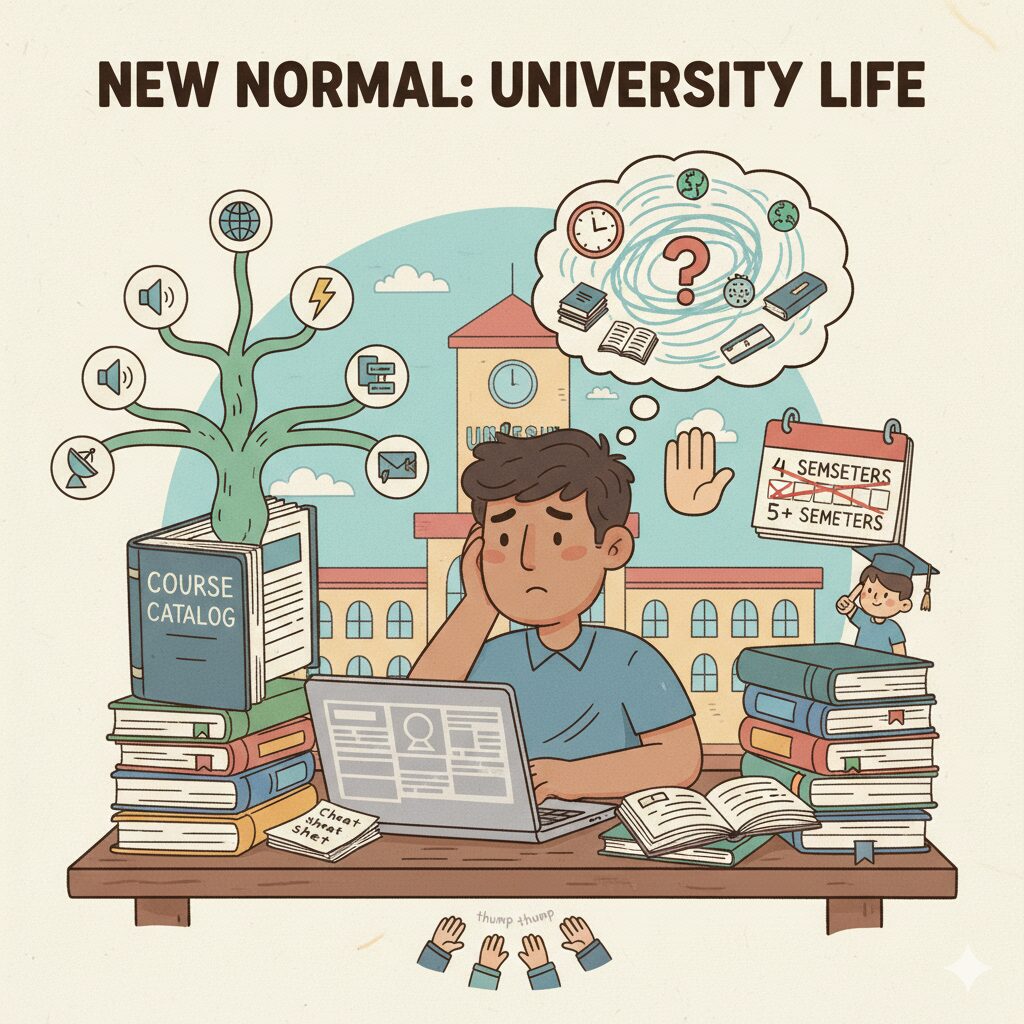
It has been nearly two weeks since the university has started. I am adjusting to the new normal. It is getting tough to find free time, but today I have some.
I have started to get a feel for the way education works here. I experience plenty of differences, from the way the course is structured to the way the course is taught. Also, the tests are going to be different.
So let’s start.
Course Structure
The course structure offers a lot of flexibility in the choice of subjects. This is both good and bad. The availability of so many subjects is good. But with it also bring the stress of making decision.
The university has strong push on the academic independence and hence encourages students to make choices according to their desires. There is also a study advisor in case one is not able to decide.
So in my program, for instance, I would need 120 credits in order to complete the Master’s Program. Out of these 30 credits are mandatory subjects. This leaves 90 credits which comprises labs, seminar, thesis and electives which can be chosen from a vast catalog.
Tenure
Also, what is flexible is the master’s tenure. Though one can complete the master’s in four semesters but one need not. It was mentioned that the more realistic schedules span five semesters.
It is also possible that one might study more subjects during 5 semesters or 6 and get more than the necessary 120 credits.
This means the study plans can be completely different for each individual. So, the batch that starts off together may not be even meeting regularly.
In my own class I already see few people inclined towards audio processing, few others in communication and some towards Signal processing.
Registering for courses
The next step after making the plan is to join the courses. This process is called Registering. Registrations turn out to be crucial for the lab courses where the seats are limited. So, is the case with some of the hot subjects.
Usually ,more than 1 choice is needed for the lab course registration. This way if the first choice is not available, then the alternative will be provided.
Registration also helps the professor communicate easily with the students. They can then share the lecture notes or other resources. Also, the registered students will get informed if the classes get canceled or rescheduled.
Registration for Exams
Now, registration for a course does not imply that one can answer the exam. There seems to be a separate registration for the exams.
People can choose to attend the classes but not answer the exam. Unattempted exams don’t count as failture. One would fail only if they attempt it.
Talking about failure, one gets 4 attempts to pass a subject. If the person fails a reattempt is possible only in the next semester. This is unlike back home where the reattempt happens immediately.
After 4 attempts, the student is ex-matriculated (expelled from the University). Since the mandatory subjects can’t be changed they need to be passed within 4 attempts. Whereas, for the electives one can change the elective if he struggles.
Attendance & Assignments
The lectures here are 1.5 hrs each. The best part here so far is that attendance is not mandatory. Though it is highly recommended. Similarly, there are no assignments over the course of the lecture period.
Good! Yes, but it also would mean that the individual has to be disciplined to study regularly. Otherwise, it is easy to not study for the entire semester and be faced with an insurmountable exam in the end.
Reference Material
How would one know what to study if one doesn’t attend classes? The reference material…
The lecture notes also referred to as script by the professors are available in its entirety. The things taught in the class closely follow the script.
It is possible to read the script (that’s like 300-400 slides) at home and still do well in the test. Also, any other reference works equally good as long as all the topics are studied.
Knocking on tables
The end of lectures have a surprise in it. German’s knock on the table as a sign of appreciation to the lecturer. This is similar to clapping after the end of a presentation. It also serves to wake up sleepy students!
Semester Exams
I can’t comment about it just yet. But there are already a few peculiarities.
First, the exam might be written or oral. It depends on the professor. If it is written then there is often an option to answer the paper in German.
Secondly, we can carry cheat sheets! I was surprised when I heard that. Most subjects allow one or two A4 sheets written with whatever. But it needs to be hand written. Some subjects also allow carrying any amount of material like even books. But, the rule of thumb that I understand is that the more flexible the subject is regarding carrying cheat sheets, the more difficult the exam is.
Reflections on the first two weeks
Overall, the past weeks has been fascinating. I find myself slowly settling into a rhythm. I am now able to manage feeding myself and attending lectures. This was my primary concern before the classes started.
The new worry that is replacing the old is about how to manage the pace of these subjects that I have taken. But eventaully this will settle too.






Leave a Reply
Only people in my network can comment.