Blog

  • Diwali Party

    Diwali Party

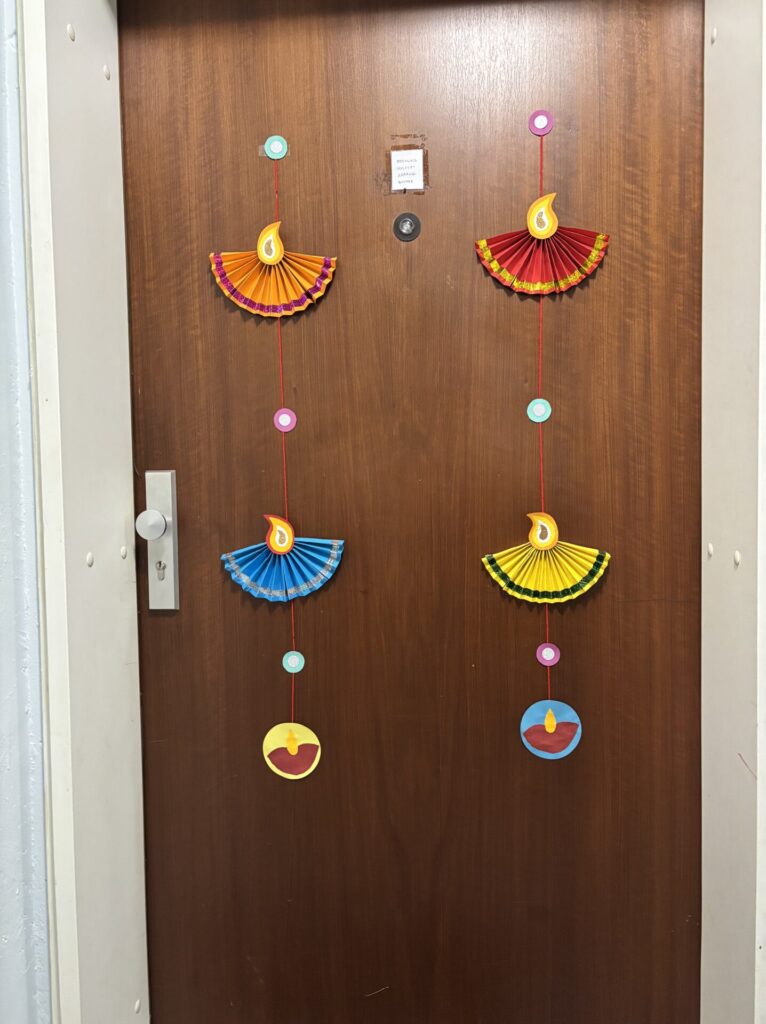
    The Diwali party at my home marked exactly 1 month since I arrived to Germany. During this month, I was lucky to join a Hike, 2 potlucks and 1 very amazing Diwali party.

    My house mate (let’s call her Apurwa for the post) put in a lot of effort in making this a success. She invited around 30 of her friends — and me. Luckily for me, I happen to live here so I was unavoidably invited 😉.

    The preparations had started long before the party with meticulous planning for gifts and food. Every guest received a gift bag thoughtfully filled with lovely card, incense, candles, sweets, candies and dry fruits for each.

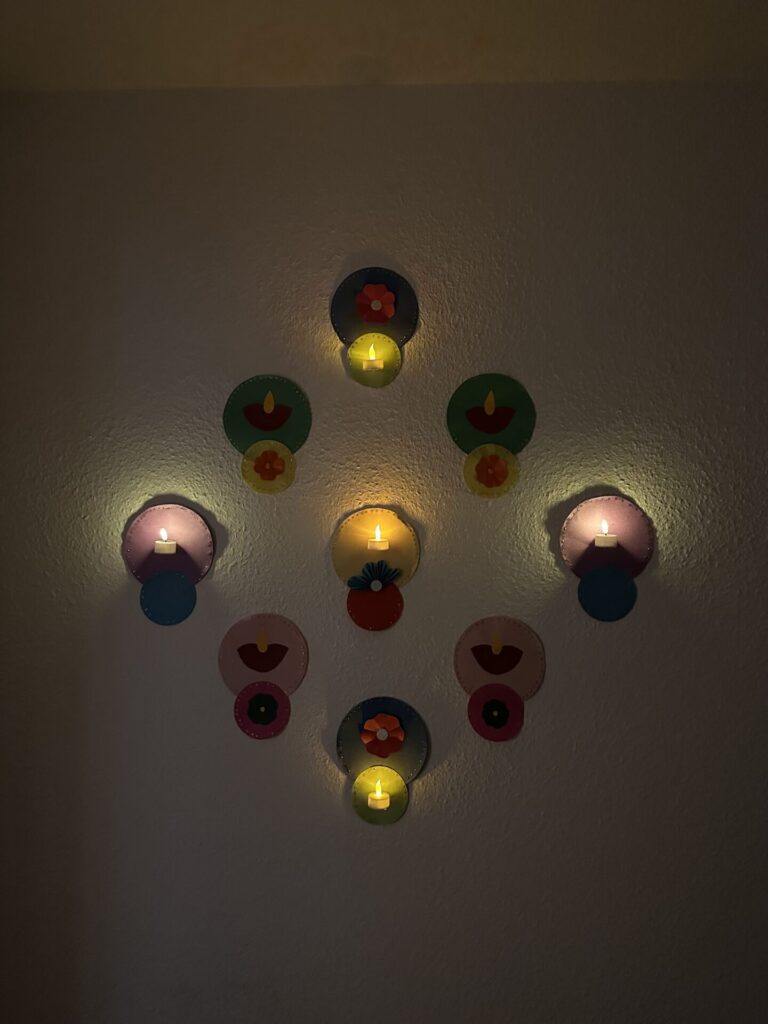
    Things really picked up pace 2 days before the party, when some of her friends started coming home to help with the decoration. It was always fun to meet new people as I returned late from the university. It made my evenings interesting to see the house slowly getting decorated.

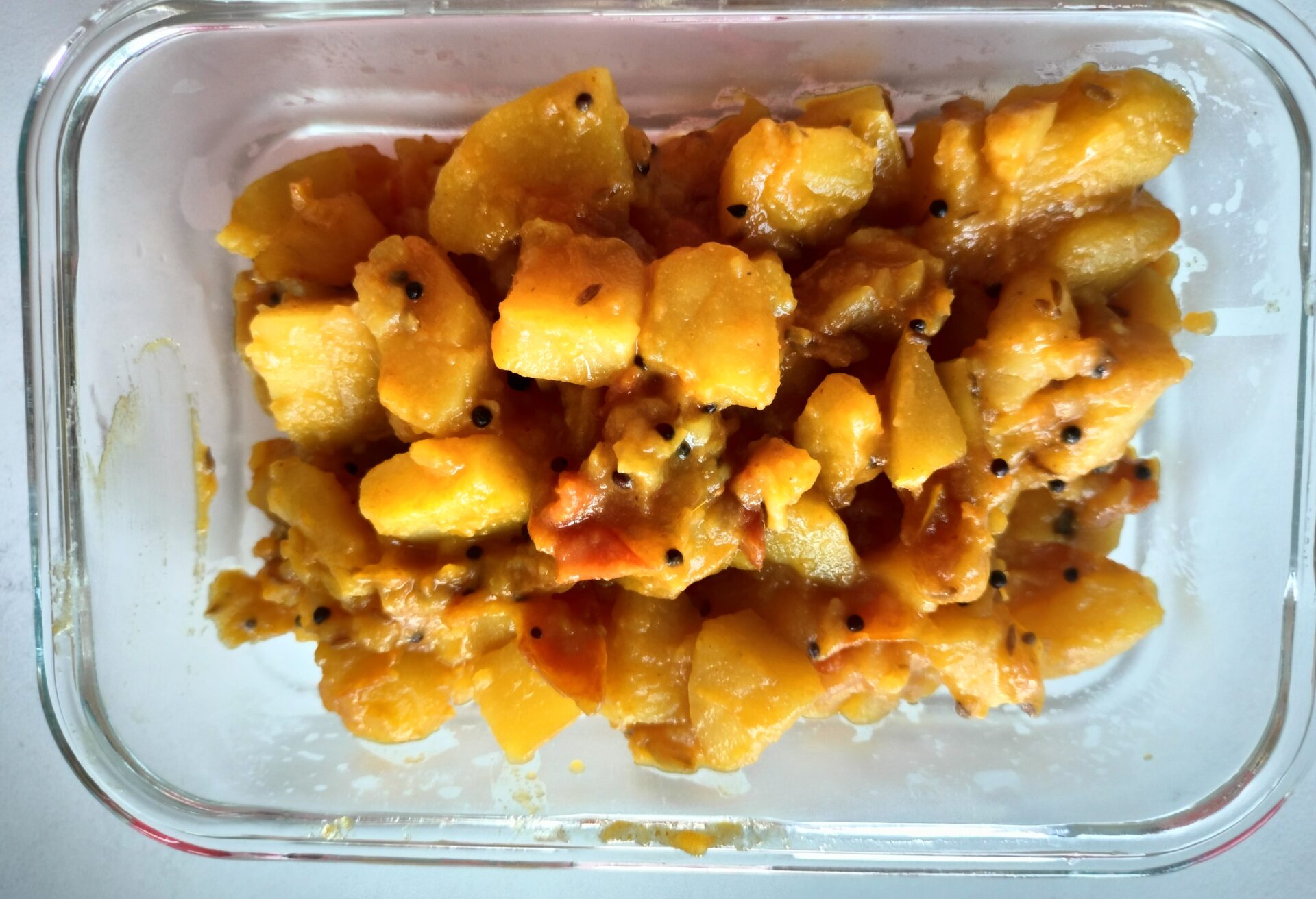
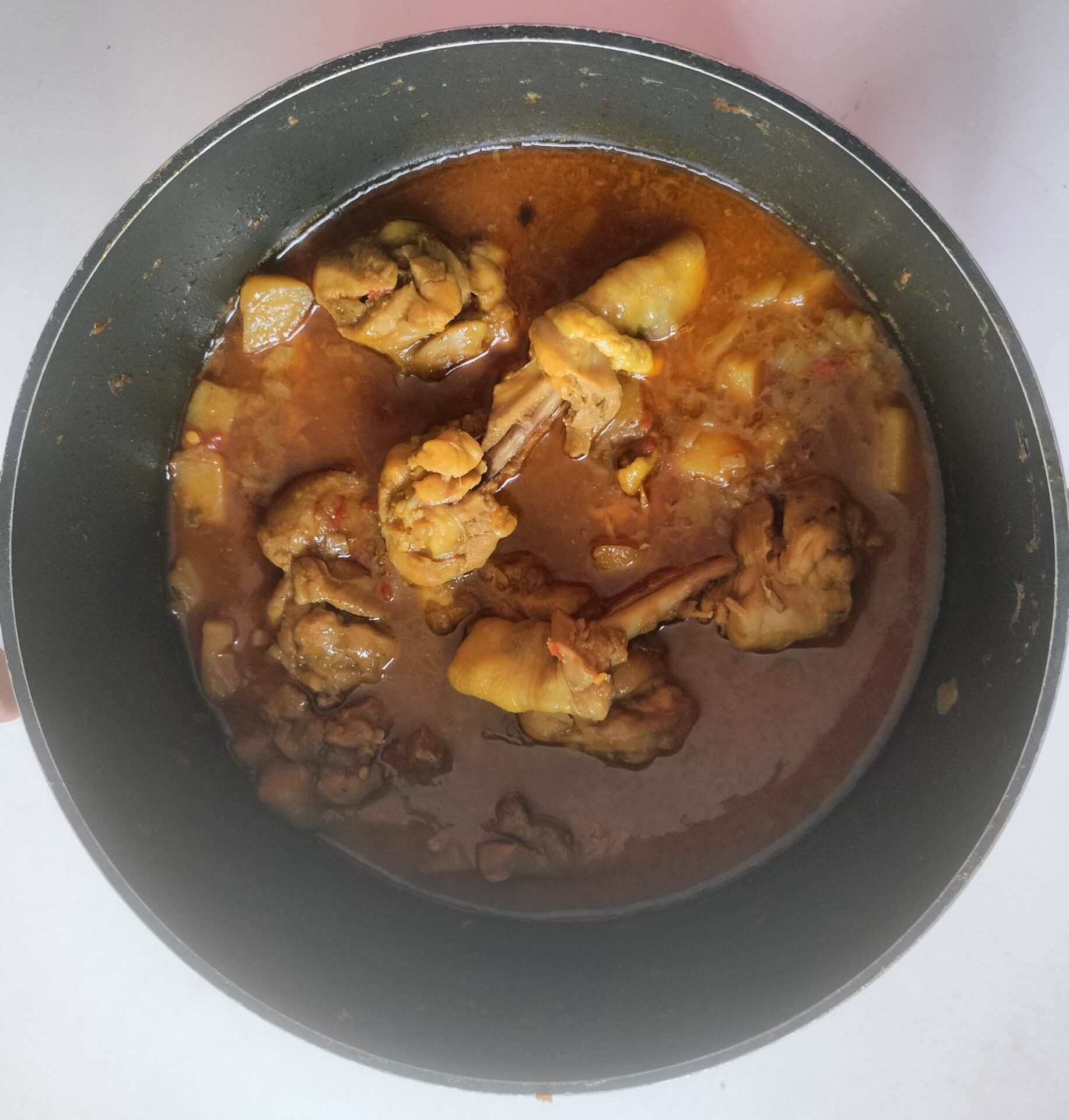
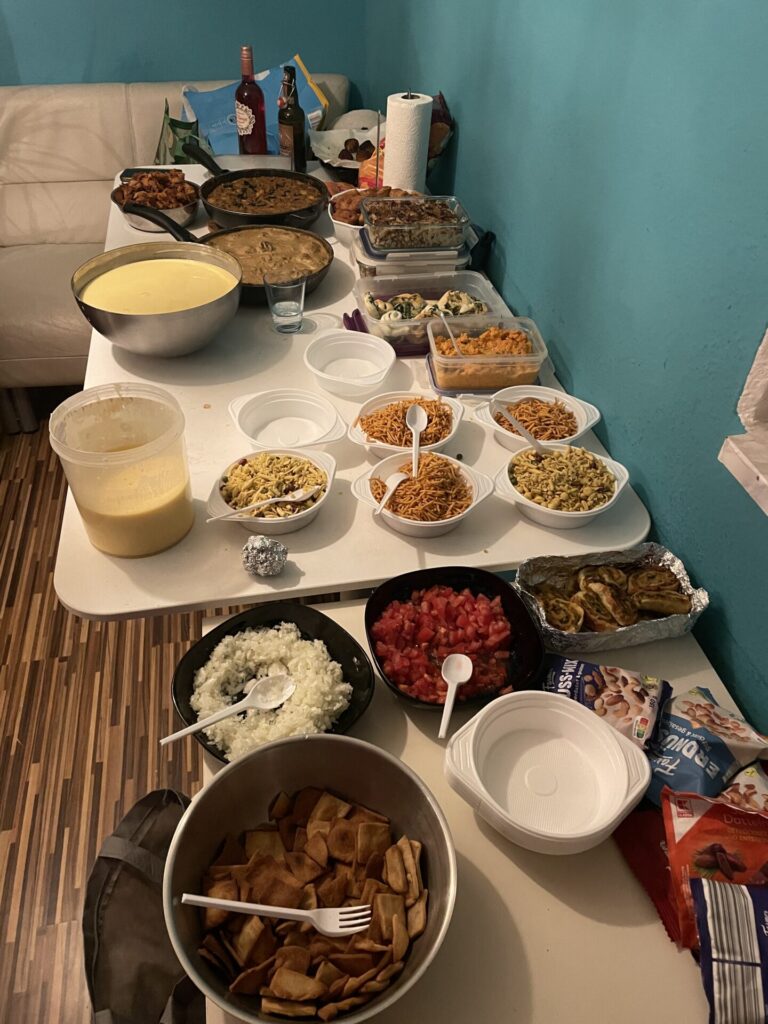
    Then came the big day, with a long list of things to be prepare. The party was a potluck but as a host Apurwa wanted to cook Boondi laddu, malai kofta, Black gram, Chaat, and rice.

    She needed help and of course she can’t exactly rely on me. My highest culinary achievement so far has been cooking Sambar in one hr. So, she called on 4 of her friends to help.

    Six of us started this cooking marathon with lots of energy in the afternoon. I wasn’t entirely sure that we would be able to do everything. Amidst the laughs and jokes we somehow managed to cook it all.

    Food! This is not all!!

    I still had one small problem – I hadn’t packed any traditional dress with me. I never expected my first month to be so festive. Fortunately, one of the friends let me borrow the extra kurta which he brought for those who didn’t have one.

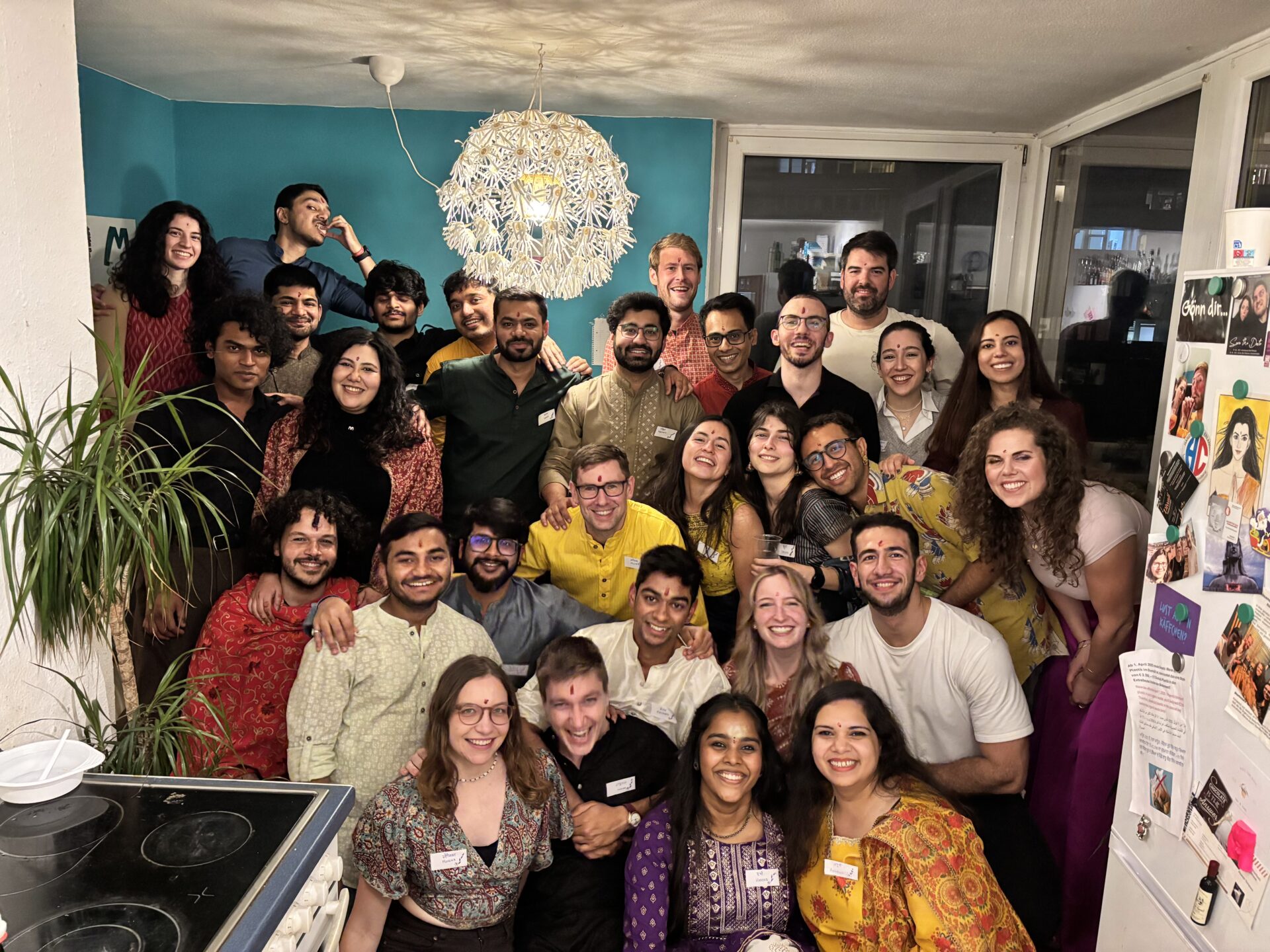
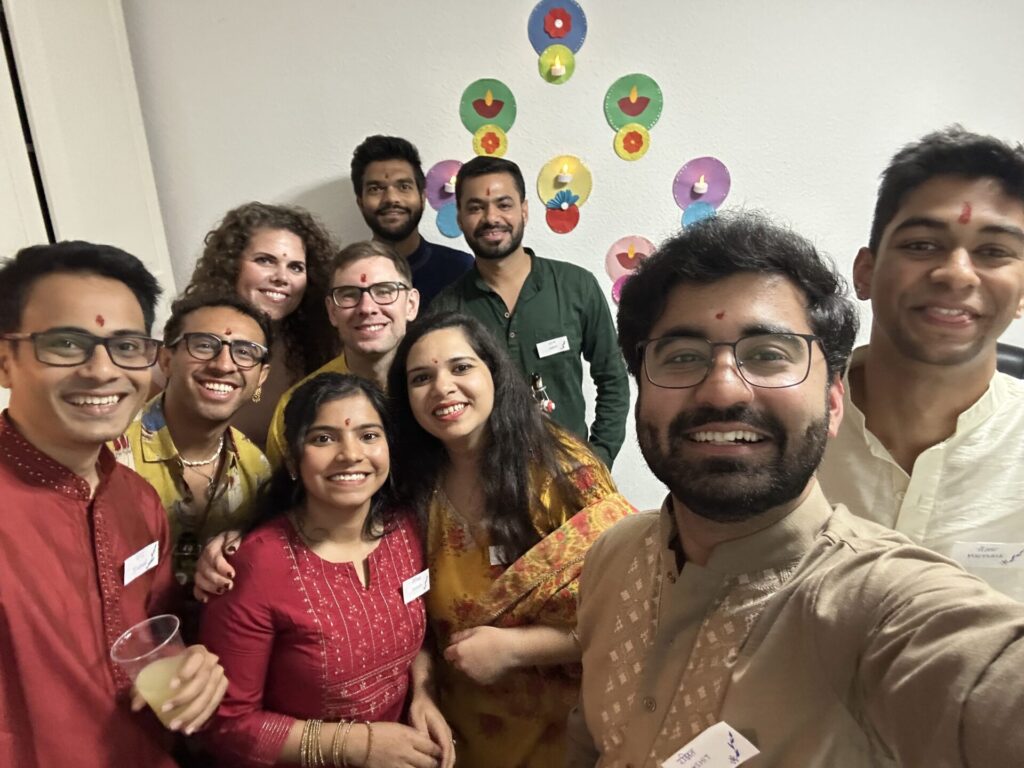
    The party started at 6 pm and slowly started gathering momentum. There were plenty of food, drinks, dance and laughs. Guests came from Spain, Columbia, Egypt, Germany, Turkey and many more places. Seeing all of them dressed in Indian wear, dancing to Indian songs and enjoying Indian food was heartwarming.

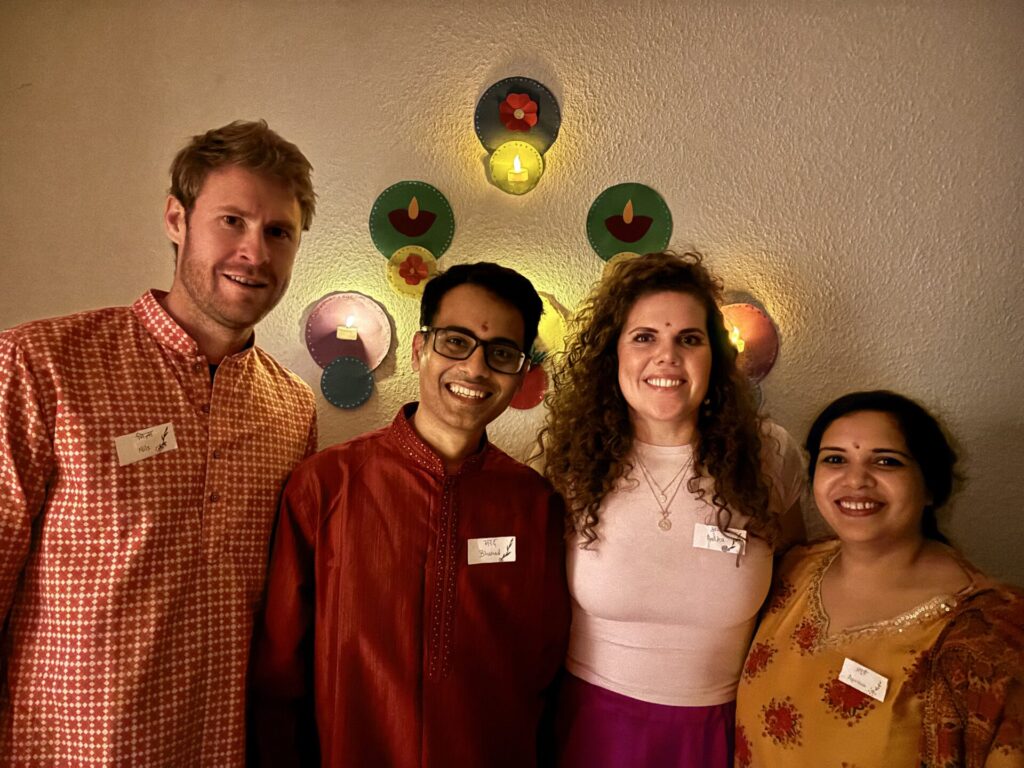
    The 4 house mates

    As the night went on, some guests started returning home. Then when the late night game of charades started, it pumped the energy back into people.

    The party ended at 3 am – which magically became 2 am as the Daylight saving ended in Germany! Overall, it was a wonderful experience for me. I can’t yet say I made friends – that needs time and trust – but I certainly have made some great acquaintances. Hope to see them again soon.

    I can’t thank everyone enough for such a truly wonderful time.

    Fediverse Reactions
  • ECB through LTI
  • Summary
  • Reference
  • Introduction

    This is a summary of the topic Equivalent complex representation. In this we discuss why we need such a representation. It is then followed by some more mathematical manipulation which makes it more convenient to generate and transmit signals. Finally we conclude the section with ECB signal and its interaction with Filters.

    Motivation

    When analyzing any digital communication modulation schemes it will be useful we can separate the modulation or the mixing of the carrier from the information itself. This allows us to analyze the modulation independent of the center frequency. This motivation drives us to use the Equivalent complex baseband representation of the transmitted RF signals.
    To develop an intuition about this process it is easy to think of the transmitted RF signal as just the up-converted baseband signal. So, ideally a down-conversion should bring us back to the baseband. This means that if we can write the baseband signal for any RF signal then we can neglect the carrier frequency and study the modulation at the baseband. In this case the baseband signal is the ECB and of the transmitted RF signal.
    However, the details reveal a subtle complication. Now let us consider the reverse situation and ask this question. What if the RF signal was not generated in baseband and up-converted? Instead if RF frequency was generated directly, can we now say for sure that the down-converted signal has the same information as the RF signal? This is the reason behind the detailed analysis that follows.

    Mathematical Reasoning

    ECB is an equivalent representation of the signal which gets transmitted (RF signal) . The important thing to notice is that the only real signals can be transmitted physically. This is an important fact around which the entire ECB representation works.

    Now for real signals we have

    $$
    X(f) = X^*(-f)
    $$

    [!Note] Proof: \(X(f) = X^*(-f)\)

    $$
    \begin{aligned}
    \mathcal{F}(x(t)) = X(f) &= \int_{-\infty}^{\infty}x(t)e^{-j\omega t} dt \\
    \mathcal{F}(x^*(t)) &= \int_{-\infty}^{\infty}x^*(t)e^{-j\omega t} dt \\
    &= \left(\int_{-\infty}^{\infty}x(t)e^{j\omega t}\right)^* dt \\
    &= X^*(-f)
    \end{aligned}
    $$

    Since x(t) is real =>

    $$
    x(t) = x^*(t)
    $$

    Thus,

    $$
    X(f) = X^*(-f)
    $$

    The above statement means that the negative frequency holds the same information as the positive. Hence we can get rid of one side. We shall be using this fact in the next steps.

    Analytic Signals from RF

    Before we get to the baseband representation (ECB) we encounter what is called the analytic representation. The analytic signal is the RF signal without the negative part of the frequency spectrum. This still has the same information as the RF signal as seen in the previous section.
    Already at this point the signal seizes being a real signal and it can’t be transmitted directly anymore . The analytic signal is represented by \(x^+(t)\) and its Fourier transform \(X^+(f)\). In this section we get to the time and frequency domain representation of analytic signals.
    The idea is straight forward. We just need to keep the positive side and subtract the negative. Mathematically it can be achieved using the signum function (also called sign function) defined as

    $$
    \operatorname{sgn}(x) =
    \begin{cases}
    -1, & x < 0 \\ 0, & x = 0 \\ 1, & x > 0
    \end{cases}
    $$


    $$
    X^+(f) = c[1+sgn(f)]X_{RF}(f)
    $$

    we use the constant c since we would like to keep the energy of both the signals same we can compute c. c can be computed as follows

    $$
    \begin{aligned}
    E_{X_{RF}} &= E_{X^+}\\
    E_{X_{RF}} &= \int_{-\infty}^{\infty}\left|c[1+sgn(f)]X_{RF}(f) \right|^2\\
    &= \int_{0}^{\infty}\left|c2X_{RF}(f) \right|^2\\\
    &= 2c^2E_{X_{RF}}\\
    c &= \frac{1}{\sqrt{2}}
    \end{aligned}
    $$

    Taking the inverse Fourier transform we get

    $$
    \begin{aligned}
    x^+(t) &= \frac{1}{\sqrt{2}}[x_{RF}(t) + x_{RF}(t)*\mathcal{F}^{-1}(x_{RF}(t))]\\
    &= \frac{1}{\sqrt{2}}[x_{RF}(t) + j(x_{RF}(t)*\frac{1}{\pi t})] \quad \text{[Since $\mathcal{F}^{-1}(x_{RF}(t)) = \frac{j}{\pi t}$]}\\
    &=\frac{1}{\sqrt{2}}[x_{RF}(t) + j\mathcal{H}(x_{RF}(t))]
    \end{aligned}
    $$

    where
    \(\mathcal{H}(x(t)) = x_{RF}(t)*\frac{1}{\pi t}\) is called the Hilbert transform

    [!note] Proof: \(\mathcal{F^{-1}}(sgn(f)) = \frac{j}{\pi t}\)

    $$
    \mathcal{F^{-1}}(sgn(f)) = \int_{-\infty}^{0}e^{j2 \pi f t}df + \int_{0}^{\infty}e^{j2 \pi f t}df
    $$

    This clearly is not integrable as the two integrands are sinusoids. Hence, we need a trick.
    We will define 4

    $$
    \begin{aligned}
    sgn(x) &= \lim_{a \to 0} e^{-a|f|} sgn(f) \\
    &= \lim_{a \to 0}[e^{-af}u(f) – e^{af}u(-f)] \\
    \end{aligned}
    $$

    Now taking the inverse Fourier transform

    $$
    \begin{aligned}
    \mathcal{F^{-1}}(X(f)) &= \int_{-\infty}^{\infty}X(f)e^{j2 \pi f t} df \\
    &= \lim_{a \to 0}\left[\int_{0}^{\infty}e^{-af}e^{j2 \pi f t}df – \int_{-\infty}^{0}e^{af}e^{j2 \pi f t}df \right]\\
    &= \lim_{a \to 0}\left[\int_{0}^{\infty}e^{-(a – j2 \pi t)f}df – \int_{-\infty}^{0}e^{(a + j2 \pi t)f}df \right]\\
    &= \lim_{a \to 0} \left[ \frac{e^{-(a – j2 \pi t)f}}{-(a – j2 \pi t)} \right]_{0}^{\infty} – \lim_{a \to 0} \left[ \frac{e^{(a + j2 \pi t)f}}{a + j2 \pi t} \right]_{-\infty}^{0} \\
    &= – \frac{1}{j2\pi t} – \frac{1}{j 2 \pi t}\\
    &= \frac{j}{\pi t}
    \end{aligned}
    $$

    Transformation: RF to ECB

    Now that we have the analytic signal, ie. the signal where the negative frequencies are 0 it is a matter of simple downshift to get the baseband.
    Thus we have

    $$
    X(f) = X^+(f+f_0)
    $$

    or equivalently we have in time domain
    $$
    \begin{aligned}
    x(t) &= x^+(t)e^{-j2\pi f_0t}\
    &= \frac{1}{\sqrt{2}}[x_{RF}(t) + j\mathcal{H}(x_{RF}(t))]e^{-j2\pi f_0t}
    \end{aligned}
    $$

    Finally we have the important relation that converts RF to ECB

    $$
    x(t) = \frac{1}{\sqrt{2}}[x_{RF}(t) + j\mathcal{H}(x_{RF}(t))]e^{-j2\pi f_0t}
    $$

    Transformation: ECB to RF


    This is the reverse transformation of what we did so far. We would like to get the RF signal from the ECB. This part is relatively straight forward. We just need to take the baseband signal and up-convert and keep only the real part. The real signal is the original RF signal we started with

    $$
    x_{RF}(t) = \sqrt{2}Re(x(t)e^{j2\pi f_0t}) = \frac{x(t)e^{j2\pi f_0t} + x^*(t)e^{-j2\pi f_0t}}{\sqrt{2}}
    $$
    or the Fourier transform
    $$
    X_{RF}(f) = \frac{1}{\sqrt{2}}(X(f-f_0) + X(-(f+f_0))
    $$


    *The above expression takes the ECB and shifts by up by \(f_0\). Also it makes another copy which reflects around 0 and shifts down by \(f_0\)*

    ECB in quadrature form

    Motivation

    We saw in [[Equivalent Complex Baseband]] that the RF signal can be represented by ECB. ECB is a complex signal. So the question remains on how to generate these signals in the real world. This section provides a practical way of producing these signals and using it.

    ECB Quadrature to RF

    For practical use we would like to generate these ECB signals at baseband and have a way to modulate this to the RF frequency. We start with the describing expanding the ECB into real and imaginary part. And then we proceed by substituting these expressions to get the relevant RF.

    We can split the ECB signal into real and imaginary part and call it in phase and quadrature components. The reason for the naming becomes apparent when the derivation ends with multiplication of cos and sin waves.

    $$
    x(t) = x_I(t) + jx_Q(t)
    $$

    Then we know to get RF frequency it needs to be multiplied by the center frequency and considering only the real part

    $$
    \begin{aligned}
    x_{RF}(t) &= \sqrt{2}Re[x(t)e^{j2\pi f_0t}] \\
    &= \sqrt{2}Re((x_I(t) + jx_Q(t))(\cos{2\pi f_0t} + j \sin{2\pi f_0t})\\
    &= \sqrt{2}(x_I(t)\cos{2\pi f_0t} – x_Q(t) \sin{2\pi f_0t})
    \end{aligned}
    $$
    $$
    \boxed{x_{RF}(t)= \sqrt{2}(x_I(t)\cos{2\pi f_0t} – x_Q(t) \sin{2\pi f_0t})}
    $$

    RF to ECB quadrature

    The section derives the general conversion first. It is then followed by the more practical conversion as well.

    In order to obtain the ECB from RF we have to: get the analytic function, down-convert and scale

    $$
    \begin{aligned}
    x(t) &= \frac{1}{\sqrt{2}}x^+(t) e^{-j2\pi f_0t} \\
    &= \frac{1}{\sqrt{2}} (x_{RF}(t)+ j\mathcal{H}(x_{RF}(t))(\cos {2\pi f_0t} – j\sin{2\pi f_0t})\\
    &= \frac{1}{\sqrt{2}}(x_{RF}(t)\cos{2\pi f_0t}+\mathcal{H}(x_{RF}(t)\sin{2\pi f_0t}) + j (\mathcal{H}(x_{RF}(t)\cos{2\pi f_0t} – x_{RF}(t)\sin{2\pi f_0t})
    \end{aligned}
    $$

    Thus we have

    $$
    \begin{align}
    \boxed{x_I(t) = \frac{1}{\sqrt{2}}(x_{RF}(t)\cos{2\pi f_0t}+\mathcal{H}(x_{RF}(t)\sin{2\pi f_0t})}\\
    \boxed{x_Q(t) =\frac{1}{\sqrt{2}}(\mathcal{H}(x_{RF}(t)\cos{2\pi f_0t} – x_{RF}(t)\sin{2\pi f_0t})}
    \end{align}
    $$

    The above expressions can convert any RF frequency down to its ECB in quadrature form. This expression is particularly complex due to the presence of Hilbert transformer and so many terms. Firstly a Hilbert transformer which spans the entire frequency range is not practical and these many terms complicate the process.

    Intuition behind the simpler version

    This can be simplified if we make an assumption that the our signal of interest is usually band limited. This assumption simplifies the case as we don’t have to bother about the entire spectrum from 0 to infinity. In other words, the spectrum is 0 everywhere other than the band of interest. Under this assumption one can avoid the Hilbert transform but instead use a low pass filter.

    Mathematical proof

    From the basic definition of ECB we have

    $$
    \begin{align}
    X(f) = \frac{1}{\sqrt{2}}(1 + sgn(f+f_0))X_{RF}(f+f_0)
    \end{align}
    $$

    The signum function is 0 below \(-f_0\) and 1 after that. But since the signal is band-limited this implies that the signal after down-conversion resides only between \(-f_0 \leftrightarrow f_0\) . Thus \((1 + sgn(f+f_0)\) can be replaced by a rectangle centered at 0 with a width of \(2f_0\). This in frequency domain is a low pass filter.
    Thus we have

    $$
    \begin{align}
    X(f) &= \sqrt{2}.rect\left( \frac{f}{2f_0} \right)X_{RF}(f+f_0) \quad \text{[Since $(1 + sgn(f+f_0)$ scales to 2]}\\
    \end{align}
    $$

    Taking inverse Fourier transform

    $$
    \begin{align}
    x(t) &= \sqrt{2}h_{LP}(t)*(x_{RF}(t)e^{-j2\pi f_0t})\\
    &= \sqrt{2}h_{LP}(t)*(x_{RF}(t)(\cos{(-2\pi f_0t)} + \sin{(-2\pi f_0t)})\\
    \end{align}
    $$
    $$
    \begin{align}
    \boxed{x_I(t) = \sqrt{2}h_{LP}(t)*(x_{RF}(t)(\cos{(2\pi f_0t)}}\\
    \boxed{x_Q(t) = -\sqrt{2}h_{LP}(t)*(x_{RF}(t)(\sin{(2\pi f_0t)}}\\
    \end{align}
    $$

    This is the same as what was described in the intuition section.

    Analysis on synchronization error

    We now have expressions to go from ECB to RF and back. ECB to RF is done at the transmitter and RF to ECB is done at the receiver. Often there will be an offset in the frequency and phase of the oscillators at the TX and RX. This section we shall see how the received signal gets impacted.

    Let us assume that ECB signal at the transmitter be

    $$
    s(t) = s_I(t) + j s_Q(t)
    $$

    Thus we get the transmitted RF as

    $$
    s_{RF}(t) = \sqrt{2}Re(s(t)e^{j2\pi f_0t})
    $$

    The received signal now is given by

    $$
    \begin{align}
    r(t) &= \sqrt{2}h_{LP}(t) * (s_{RF}(t)e^{-j2\pi (f_0 + \Delta f)t + \phi })\\
    &= 2 h_{LP}(t)*[(s_I(t)\cos({2\pi f_0 t}) – s_Q(t)sin({2\pi f_0 t}))(\cos({2\pi (f_0 + \Delta f)t + \phi })-j\sin({2\pi (f_0 + \Delta f)t + \phi }))]\\
    &=s_I(t)(\cos(2\pi\Delta ft+\phi)+j \sin (2\pi\Delta ft+\phi)) + s_Q(t)(\cos(2\pi\Delta ft+\phi)+j \sin (2\pi\Delta ft+\phi))\\
    &= (s_I(t) + js_Q(t))e^{-j2\pi \Delta ft + \phi }\\
    &= s(t)e^{-j2\pi \Delta ft + \phi }
    \end{align}
    $$

    Thus we have that the received signal is multiplied by a complex exponential whose frequency is the difference in frequency and phase is the difference in phase

    $$
    \boxed{r(t) = s(t)e^{-j2\pi \Delta ft + \phi }}
    $$

    ECB through LTI

    Motivation

    Any digital system would make use of filters. Using the ECB representation we are able to bring the RF frequency down to the base-band. Now we would like to determine the equivalent filter that should operate in base-band frequencies so that we get the same response as the filter at the HF frequency.
    We would like to initially know if such a system exists. If it does then we would like to know how to build such a system.

    Proof of existence

    We start with a filter in RF frequency with the following setup at the RF frequency

    $$
    Y_{RF}(f) = X_{RF}(f)H_{RF}(f)
    $$

    Let us assume that we have a ECB works the same way for H(f) as it works for X(f) and Y(f) we should get

    $$
    Y(f) = H(f)X(f)
    $$

    where

    $$
    \begin{align}
    X_{RF}(f) &= \frac{1}{\sqrt{2}}(X(f-f_0) + X^*(-(f+f_0)))\\
    Y_{RF}(f) &= \frac{1}{\sqrt{2}}(Y(f-f_0) + Y^*(-(f+f_0)))\\
    H_{RF}(f) &= c_h(H(f-f_0) + H^*(-(f+f_0)))\\
    \end{align}
    $$

    If this was true, then we should be able to start with the RHS and get the LHS.

    $$
    \begin{align}
    X_{RF}(f)H_{RF}(f) &= \frac{c_h}{\sqrt{2}}(X(f-f_0) + X^*(-(f+f_0)))(H(f-f_0) + H^*(-(f+f_0)))\\
    &= \frac{c_h}{\sqrt{2}}(X(f-f_0)H(f-f_0) + X^*(-(f+f_0))H^*(-(f+f_0)) \\
    & +X(f-f_0)H^*(-(f+f_0)) + X^*(-(f+f_0))H(f-f_0))\\
    &= \frac{c_h}{\sqrt{2}}(X(f-f_0)H(f-f_0) + X^*(-(f+f_0))H^*(-(f+f_0)) \\
    &= \frac{c_h}{\sqrt{2}}(Y(f-f_0)+ Y^*(-(f+f_0)))
    \end{align}
    $$

    this will be equal to \(Y_{RF}(f)\) if \(c_h = 1\)

    So we have,

    $$
    \begin{align}
    H_{RF}(f) &= (H(f-f_0) + H^*(-(f+f_0)))\\
    \end{align}
    $$

    [!note]
    There is a difference in scaling between the H and X.

    The difference in scaling makes the ECB for transfer function different by a scaling factor.
    RF to ECB:

    $$
    \boxed{h(t)= \frac{1}{2}[h_{RF}(t) + j\mathcal{H}(h_{RF}(t))]e^{-j2\pi f_0t}\}}
    $$

    ECB to RF:

    $$
    \boxed{
    h_{RF}(t) = 2Re(h(t)e^{j2\pi f_0t}) = h(t)e^{j2\pi f_0t} + h^*(t)e^{-j2\pi f_0t}
    }
    $$

    ECB filter action

    The ECB representation of both the input and the filter response in complex in the ECB. Hence they can be expanded to see how it can be realized

    $$
    \begin{align}
    h(t) &= h_I(t) + jh_Q(t)\\
    x(t) &= x_I(t) + jx_Q(t)\\
    y(t) &= h(t)*x(t)\\
    &= ( h_I(t) + jh_Q(t))*(x_I(t) + jx_Q(t))\\
    &= (x_I(t)*h_I(t)-x_Q(t)*h_Q(t)) + j(x_Q(t)*h_I(t) + x_I(t)*h_Q(t))
    \end{align}
    $$

    Simplification

    There are the following steps to get the ECB from RF

    1. Get the analytic signal
    2. Translate down
    3. scale
      Since the input signal is already analytic for a ECB system, we can relax the condition on the transfer function. This means for the transfer function we can skip step 1 and the end result would still be the same filter provided that the input is ECB.

    They an alternate simpler system

    $$
    \tilde{H}(f) = H_{RF}(f)e^{-j2\pi f_0t}
    $$

    will perform the same way as H(f).

    Summary

    We see that ECB is a convenient representation of the signals in baseband. This helps in studying the modulation independent of the carrier frequency. We also see how the signals can be transformed between these two states. Finally, we also deduce the effects of mismatch frequency and phase between the transmitter and the receiver on the ECB representation.

    Reference

    1. Fischer, R. F. H., & Huber, J. B. (2024). Digital Communications: A Foundational Approach. Cambridge: Cambridge University Press.

    Fediverse Reactions
  • Masters! Get set! Go!

    Masters! Get set! Go!

    It has been nearly two weeks since the university has started. I am adjusting to the new normal. It is getting tough to find free time, but today I have some.

    I have started to get a feel for the way education works here. I experience plenty of differences, from the way the course is structured to the way the course is taught. Also, the tests are going to be different.

    So let’s start.

    Course Structure

    The course structure offers a lot of flexibility in the choice of subjects. This is both good and bad. The availability of so many subjects is good. But with it also bring the stress of making decision.

    The university has strong push on the academic independence and hence encourages students to make choices according to their desires. There is also a study advisor in case one is not able to decide.

    So in my program, for instance, I would need 120 credits in order to complete the Master’s Program. Out of these 30 credits are mandatory subjects. This leaves 90 credits which comprises labs, seminar, thesis and electives which can be chosen from a vast catalog.

    Tenure

    Also, what is flexible is the master’s tenure. Though one can complete the master’s in four semesters but one need not. It was mentioned that the more realistic schedules span five semesters.

    It is also possible that one might study more subjects during 5 semesters or 6 and get more than the necessary 120 credits.

    This means the study plans can be completely different for each individual. So, the batch that starts off together may not be even meeting regularly.

    In my own class I already see few people inclined towards audio processing, few others in communication and some towards Signal processing.

    Registering for courses

    The next step after making the plan is to join the courses. This process is called Registering. Registrations turn out to be crucial for the lab courses where the seats are limited. So, is the case with some of the hot subjects.

    Usually ,more than 1 choice is needed for the lab course registration. This way if the first choice is not available, then the alternative will be provided.

    Registration also helps the professor communicate easily with the students. They can then share the lecture notes or other resources. Also, the registered students will get informed if the classes get canceled or rescheduled.

    Registration for Exams

    Now, registration for a course does not imply that one can answer the exam. There seems to be a separate registration for the exams.

    People can choose to attend the classes but not answer the exam. Unattempted exams don’t count as failture. One would fail only if they attempt it.

    Talking about failure, one gets 4 attempts to pass a subject. If the person fails a reattempt is possible only in the next semester. This is unlike back home where the reattempt happens immediately.

    After 4 attempts, the student is ex-matriculated (expelled from the University). Since the mandatory subjects can’t be changed they need to be passed within 4 attempts. Whereas, for the electives one can change the elective if he struggles.

    Attendance & Assignments

    The lectures here are 1.5 hrs each. The best part here so far is that attendance is not mandatory. Though it is highly recommended. Similarly, there are no assignments over the course of the lecture period.

    Good! Yes, but it also would mean that the individual has to be disciplined to study regularly. Otherwise, it is easy to not study for the entire semester and be faced with an insurmountable exam in the end.

    Reference Material

    How would one know what to study if one doesn’t attend classes? The reference material…

    The lecture notes also referred to as script by the professors are available in its entirety. The things taught in the class closely follow the script.

    It is possible to read the script (that’s like 300-400 slides) at home and still do well in the test. Also, any other reference works equally good as long as all the topics are studied.

    Knocking on tables

    The end of lectures have a surprise in it. German’s knock on the table as a sign of appreciation to the lecturer. This is similar to clapping after the end of a presentation. It also serves to wake up sleepy students!

    Semester Exams

    I can’t comment about it just yet. But there are already a few peculiarities.

    First, the exam might be written or oral. It depends on the professor. If it is written then there is often an option to answer the paper in German.

    Secondly, we can carry cheat sheets! I was surprised when I heard that. Most subjects allow one or two A4 sheets written with whatever. But it needs to be hand written. Some subjects also allow carrying any amount of material like even books. But, the rule of thumb that I understand is that the more flexible the subject is regarding carrying cheat sheets, the more difficult the exam is.

    Reflections on the first two weeks

    Overall, the past weeks has been fascinating. I find myself slowly settling into a rhythm. I am now able to manage feeding myself and attending lectures. This was my primary concern before the classes started.

    The new worry that is replacing the old is about how to manage the pace of these subjects that I have taken. But eventaully this will settle too.

    Fediverse Reactions
  • Photo of the day

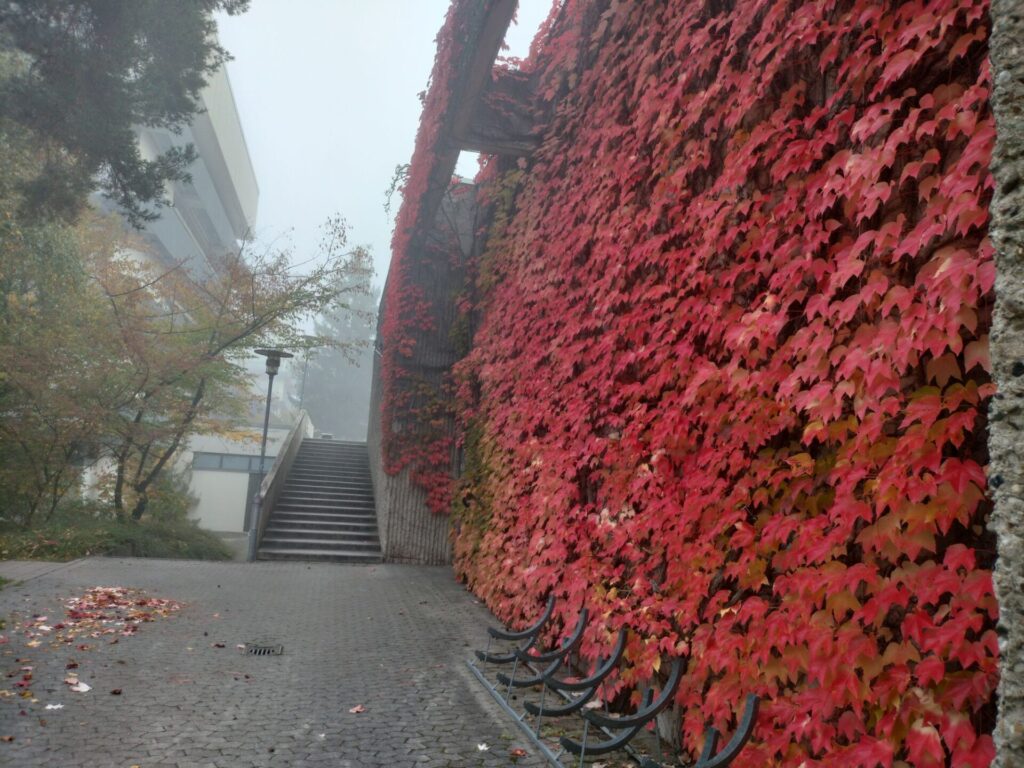
    A wall full of climbers

  • Follow this Blog

    Follow this Blog

    I have been asked in the previous week on how to follow this blog. If you have found it useful there are two ways you can follow it. You can follow using RSS reader or using any social media that supports Fediverse.

    I thought about enabling email notifications but I now decided against it. For what I know one will surely start disliking the mails and it is bound to get ignored. I know because I do the same as well.

    RSS reader (Preferred)

    RSS readers are convenient ways to follow any website. To know more about it you can read here: RSS – Consume internet consciously.

    To cut the long story short you can simply follow the steps below.

    1. Install an RSS reader. Some good ones are
    2. Go to the bottom of this webpage and click on the RSS icon. (A white dot in the bottom-left corner and two curved white line)
    3. Copy the URL and paste it in the RSS reader of your choice.

    Fediverse

    Fediverse is a distributed social media for people who would like to keep their privacy. You can read more about it here. There are several apps that are part of Fediverse like Mastadon, Peertube etc.

    In this blogs we will talk about using Threads as this is the most well know app. Important to notice is that Fediverse is in Beta in Threads. One major issue that I observe is that it only displays short posts. Hence I will highly recommend using the above RSS reader method currently.

    Firstly, to use Threads in Fediverse it needs to be enabled. Then you can look for the blog and follow it just like any other account.

    Enabling Fediverse

    You can find the detailed instructions on the official site. I am just copying it here for convenience.

    1. Click Menu in the bottom left, then click Settings.
    2. Click Account at the top, then click Fediverse sharing.
    3. Follow the onscreen prompts to learn more about sharing to the fediverse.
    4. Once you’ve reviewed the information, click Turn on sharing.

    Following the blog

    1. Go to the bottom of the page and click on Fediverse button.
    2. Copy the profile address which appears there (@blogs).
    3. Search for this address in your Fediverse app and follow.
    Fediverse Reactions
  • Kolkar

    Kolkar

    Ingredients

    1. Aunty powder: 2tbsp
    2. Oil: 2tbsp
    3. Garlic: 15 pieces
    4. Salt: to taste
    5. Tamarind juice: to taste
    6. Sugar: 0.5 tsp
    7. Mustard: 0.25 tsp
    8. Jeera: 0.5 tsp
    9. Pepper: 8 – 10
    10. Water: 0.5 l

    Procedure

    1. Mix aunty powder, salt, sugar, tamarind water (to taste) and water (consistency should not be too thin).
    2. Heat oil in pressure cooker and then add mustard, jeera, pepper.
    3. Fry garlic till it becomes reddish.
    4. Add this to the mix made earlier.
    5. Cook for 2 whistle and leave it to simmer for 5 min
    Fediverse Reactions
  • Brown Magnet and Audio Labs

    Brown Magnet and Audio Labs

    It has been the inaugural welcome week, it’s been very interesting. There has been a lot of information flow and we are meeting and making new friends from various parts of the world.

    The whole feeling is so surreal. Sitting in the classrooms after so long feels so amazing and refreshing. Also, meeting people with whom I was only chatting for so many days also feels wonderful.

    Throughout the week, we have been repeatedly told how very hard it is going to balance the extremely challenging coursework, part-time job, social circle, clubs and hobbies. But the challenge is a welcome.

    Amongst all this, I am already experiencing the effects of different cultures. For the first time, I truly recognize the comfort that comes of familiarity. I had known it all along, but the environment amplifies the feeling.

    Then there was the visit to the Audio lab at Fraunhofer – a dream come true.

    Brown Magnet

    I realized that I am a Brown magnet. I gravitate towards, and attract other Brown people more. This is not racial comment, rather just a casual observation.

    When I was in India I saw people grouping up with people from their own states. Now I see the same thing happening at a different level.

    I often find myself striking conversation or being approached by people from similar background. I observe that the humor works similar in India, Pakistan, Nepal and Bangladesh. The pronunciation is similar and it makes it slightly easier to converse.

    Whereas, when I speak to people away from India they are different in their body language. It is tough to guess what was meant as a joke.

    These are small differences but somehow I now feel they are crucial. Even though we all speak English, it is not the same information we convey with this language. I am thankful to Hollywood which makes some communication common.

    Of course, by the end of the course I shall have more in common with the rest. I will hopefully learn their cultures, language and humor.

    A packed classroom

    Audio Labs

    Today was also the first lab visit. The excitement felt like that of a 5-year old going to an amusement park. Like the good feel that you get when you are hungry and you get Biriyani?? No? I guess that analogy works only for me. But you get it. It was crazy excitement behind the composed face.

    The Audio Labs is one of the FAU facilities which is inside the Fraunhofer research labs. Under my degree program there is a possibility to focus on audio processing. But I am not sure if I will choose that path.

    I am not an audiophile but today I know that I experienced good music. I have been to theater halls, but I have never experienced good audio like today’s. I experienced really loud music which still managed to retain its quality.

    Demo

    Then also the demo on audio codecs was cool. The small software in the mobile which converts and transmits the audio goes unnoticed. Today in the demo the codec from GSM and LTE full hd quality were played simultaneously. The difference was significant.

    Something funny

    Although it was a cool demo the discussion with the professor slightly dampened the enthusiasm. Since so much is around multimedia and music I had a natural question if one has to be good with music to research in this field. The answer was slightly disappointing. Having a good sense of music is desirable, just like, to find a job easily in Germany knowing German is not necessary but highly desirable.

    Pretzel and drinks

    Now what?

    The week hasn’t concluded. This is still the fun part – enjoying the demos and instructions. The tough part is yet to begin – studying. But we are ready for the challenge. We know we will make it just like 40000 other students in the university.

    Fediverse Reactions